

Part I — Can Forgetting Be Modeled?
We often describe memory as if it were a storage box: information goes in, stays there for a while, and eventually disappears. Cognitive science suggests something much more interesting. Human memory behaves less like a collection of files and more like a dynamic information-processing system whose accessibility changes with time, experience, repetition, and context.
One of the earliest attempts to mathematically describe this process came from German psychologist Hermann Ebbinghaus. In his experiments, Ebbinghaus deliberately learned lists of meaningless syllables so that previous knowledge would interfere as little as possible. He then measured how much information was retained after different delays. His results produced what became known as the Ebbinghaus forgetting curve: memory declines rapidly after learning, but the rate of decline becomes progressively slower.
The basic idea is surprisingly intuitive. Imagine learning a completely new word today. Shortly after learning it, the memory is relatively accessible. After several hours, retrieving it may become harder. After several days, it may feel almost completely forgotten. However, the information does not necessarily vanish entirely. If you encounter the word again, you may relearn it faster than you learned it originally.
That distinction is important because forgetting is not necessarily the same as erasure.
Ebbinghaus actually measured memory using a method called savings. Instead of simply asking whether he could remember something, he measured how much faster he could relearn it after a period of forgetting. His work therefore suggested that information can become difficult to consciously retrieve while still leaving some trace that influences future learning.
Modern research has complicated the original picture even further. The familiar textbook version of the forgetting curve is often represented with an exponential decay function, but researchers have found that human forgetting is frequently better described using power-law relationships. Wixted and Ebbesen, for example, found that several types of forgetting data were better described by a power function than by several alternative mathematical forms.
This raises a fascinating computational question:
If human forgetting follows measurable patterns, can we build a computer model that behaves like a human memory system?
This is where cognitive science becomes especially interesting.
A simple computational model might represent memory strength as a variable that decreases with time. We could then define a mathematical function describing how accessibility changes:
An extremely simple model could predict that memory accessibility decreases as the time since learning increases. But human memory is not simply a clock that counts backward. Repetition changes the system.
If you study a fact once and never encounter it again, its accessibility may decline substantially. If you retrieve it repeatedly, however, each successful retrieval can alter how easily it can be accessed later. This is the foundation behind spaced repetition.
Repeated retrieval can progressively increase the persistence of a memory, producing increasingly slower rates of forgetting.
Instead of asking only:
“How quickly do humans forget?”
a computational cognitive scientist can ask:
“What rules would allow a system to predict when a particular person is likely to remember something?”
That is a much richer problem.
It turns memory from something we merely observe into something we can attempt to simulate, predict, and test.
Part II — Building a Computational Mind
One approach to this problem is to create a mathematical model using Python. Another is to use an established cognitive architecture such as ACT-R, which attempts to represent aspects of human cognition using computational mechanisms.
ACT-R is particularly interesting because it does not simply treat the brain as a generic machine-learning system. It was designed as a cognitive architecture: a framework for modeling how components of cognition interact.
For a memory experiment, imagine giving a model a collection of facts:
> Paris → capital of France
> 7 × 8 → 56
> Water → H₂O
> Neuron → basic functional unit of the nervous system
Each item can be associated with a representation of its memory strength or accessibility. The model can then simulate what happens when an item is studied, retrieved, forgotten, and encountered again.
The important variable is not simply whether the model “knows” something. Instead, we can ask how likely the model is to retrieve it at a particular moment.
This creates an interesting bridge between psychology and mathematics.
A computational experiment could begin with a simplified memory model and generate predictions for different study schedules.
For example:
Model A: Massed practice
Study → study → study → long delay
Model B: Spaced practice
Study → delay → review → longer delay → review
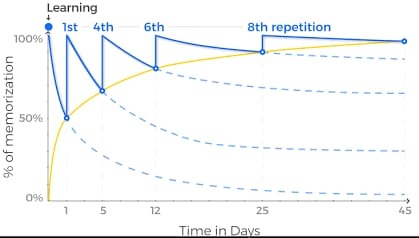
Repeated learning at increasing intervals can substantially extend the time over which information remains accessible.
We could then simulate hundreds or thousands of virtual learning trials and calculate the predicted probability of successful recall at different points in time.
The resulting curves would allow us to investigate questions such as:
Does spacing repetitions produce a measurable change in the predicted forgetting rate?
How much does one successful retrieval change future accessibility?
Does the optimal interval between repetitions depend on how strong the memory already is?
These questions become even more interesting when computational cognitive models are compared with conventional machine-learning models.
A standard machine-learning system might learn statistical relationships between variables such as:
time since last practice,
number of previous repetitions,
previous correctness,
difficulty of the item,
learner identity,
and response history.
A cognitive model, in contrast, can attempt to represent mechanisms that have psychological interpretations.
This creates a fundamental distinction:
Prediction vs. explanation.
A machine-learning model might predict that a student has an 82% chance of remembering a vocabulary item tomorrow. That could be extremely useful.
But a cognitive model asks a different question:
Why should the probability be 82%?
Perhaps the item has been successfully retrieved several times. Perhaps its memory representation has strengthened. Perhaps the delay since the previous encounter has increased. Perhaps retrieval itself has changed the future accessibility of the item.
The two approaches do not have to compete. A strong research project could compare them directly.
For example, I could build a baseline model using Python and logistic regression, then compare its predictions with a biologically inspired or cognitively motivated model.
The dataset could contain observations such as:
Variable Example
Time since previous exposure 2.5 days
Previous repetitions 4
Previous response Correct
Item difficulty Medium
Current response Correct/Incorrect
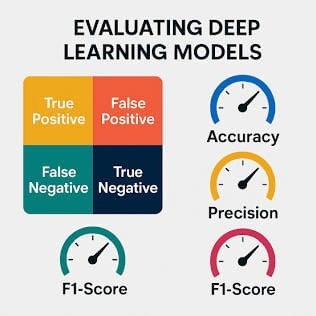
The models could then be evaluated using metrics such as prediction accuracy or log loss.
Evaluating machine-learning models using accuracy, precision, F1 score, and classification outcomes
One particularly interesting dataset for this kind of research comes from Duolingo’s Second Language Acquisition Modeling (SLAM) Shared Task. The dataset contains exercise- and phrase-level information from language learners during their first 30 days of using the application.
That makes language learning a useful environment for studying memory because learners repeatedly encounter similar vocabulary and structures over time.
However, an important scientific principle is that a dataset should not simply be used because it is convenient. The model needs to be tested against appropriate baselines, and its limitations need to be made clear.
For example, a learner’s performance may depend on much more than memory decay. Motivation, attention, prior knowledge, item difficulty, language similarity, and context can all influence performance.
Therefore, if a model predicts that someone will forget a word, that prediction should not automatically be interpreted as evidence that the person’s memory trace literally decayed by a particular amount.
A computational model is a representation of a phenomenon, not the phenomenon itself.
That distinction is one of the most important ideas in computational cognitive science.
Part III — From Forgetting Curves to Artificial Minds
Once a computational model has been built, the most interesting part begins: testing what it can and cannot explain.
Suppose we train several models on the same memory dataset.
The first might be a simple mathematical forgetting curve.
The second might incorporate repetition.
The third could be a machine-learning model using features from a learner’s history.
The fourth could be a cognitive architecture designed around psychologically motivated mechanisms.
Instead of asking which model is simply “best,” we could investigate what each model captures.
A statistical model may provide excellent predictions but offer limited insight into the mechanisms behind those predictions.
A cognitive model might make slightly different predictions but provide a more interpretable explanation of how memory accessibility changes.
This distinction is central to computational cognitive science because the goal is not necessarily to build the most powerful predictor possible. It is to develop computational explanations of cognition.
There is also an important lesson hidden inside the forgetting curve itself.
The original Ebbinghaus experiments were conducted under highly controlled conditions using meaningless material and a single participant. Modern replications and analyses have confirmed the broad phenomenon while also showing that the exact shape of forgetting depends on the experimental conditions and mathematical assumptions. A 2015 replication, for example, reproduced the general forgetting pattern while examining different mathematical descriptions of the curve.
Other research has even demonstrated situations in which forgetting can depart from the traditional curve. This means that the famous graph should not be treated as a universal law governing every memory in every person.
That is precisely why computational modeling is useful.
A model can be treated as a hypothesis.
If I propose that repetition strengthens memory according to a particular mathematical rule, I can simulate that rule and compare its predictions with real observations.
If the model fails, that failure is informative.
Perhaps the mathematical assumption is wrong.
Perhaps an important variable is missing.
Perhaps memory behaves differently depending on the type of material.
Or perhaps averaging across people is hiding important differences between individual learners.
The research process therefore becomes:
Observe → Model → Predict → Compare → Revise.
That cycle is one of the reasons computational cognitive science sits at the intersection of psychology, neuroscience, mathematics, computer science, and artificial intelligence.
It also reveals something deeper about the way we think about the human mind.
A cognitive scientist does not necessarily have to choose between seeing the mind as biological and seeing it as computational. A computational model can be a way of asking precise questions about biological cognition.
The brain is not literally a Python program.
A human memory is not literally a number stored inside ACT-R.
And an equation describing forgetting does not mean that the brain contains that equation.
Instead, these models provide formal languages for describing patterns of cognition.
That is what makes the study of forgetting so much more than a question about studying for exams.
A simple question such as “Why do I forget something I learned yesterday?” can lead to questions about information processing, learning algorithms, mathematical functions, neural systems, artificial intelligence, and the architecture of the human mind.
The next step in this project would be to build the model itself.
I could begin with a simple forgetting function, add repetition as a parameter, and generate simulated learners. Then I could compare those predictions against an open learning dataset.
From there, the model could become progressively more sophisticated: incorporating individual differences, item difficulty, retrieval history, and different spacing schedules.
The ultimate goal would not be to create a perfect digital copy of human memory.
It would be to ask a more scientifically useful question:
What is the simplest computational system that can reproduce important patterns of human remembering and forgetting?
That question lies at the heart of computational cognitive science.
And perhaps the most interesting result would not be a perfect curve.
It would be discovering where the curve breaks.
Because every unexpected prediction is an opportunity to learn something new about the mind.
Resources & Further Reading
Murre, J. M. J. & Dros, J. (2015), “Replication and Analysis of Ebbinghaus’ Forgetting Curve” — PLOS ONE.
A modern replication and mathematical analysis of Ebbinghaus’s classic work. Read the PLOS ONE paper
Ebbinghaus, H., Memory: A Contribution to Experimental Psychology.
The classic work describing early experimental research into retention, forgetting, and repeated learning. Read the translated text
Wixted, J. T. & Ebbesen, E. B. (1991), “On the Form of Forgetting.”
Research examining mathematical functions that describe forgetting. Read the research article
Tomoschuk et al., SLAM 2018 — A Memory-Sensitive Classification Model.
Describes the Duolingo-derived dataset and its use for modeling second-language learning. Read the paper
PsyNeuLink — Princeton University.
An open-source framework for computational modeling of cognitive and neural processes. Explore PsyNeuLink on GitHub
Mathematical Modeling of Human Memory.
A broader overview of mathematical approaches to modeling memory and forgetting. Read the overview